
How Troy Arrests Become Records
In Troy, one arrest can leave paper trails in several offices. The Troy Police Department handles most city arrests. Other agencies make arrests too. The Rensselaer County Sheriff, New York State Police, or a federal agency may also make one. Each custodian holds a different piece of the file. Troy Police keep the incident or arrest report. The Sheriff's Bureau of Corrections holds county booking and custody material. Once charges are filed, the court keeps the case record. No single office stands in for all three.
Troy is the county seat and Rensselaer County's largest city. It was home to 51,401 people at the 2020 Census. That mix of agencies makes it vital to know who made the arrest. Some people get an appearance ticket and go home. They never enter the Rensselaer County Correctional Facility. A person who is remanded moves into county custody at 4000 Main Street. Booking simply records identity, the charges, and custody details.
Where Troy Arrests Are Published
Troy publishes no daily arrest log, same-day booking table, or public mugshot roster. The city's strongest official route is a records request, not a live feed. County and state tools answer different questions. News and commercial sites come last. They cannot prove anyone is in custody right now.
| Channel | Purpose | Limit |
|---|---|---|
| Troy Police records | Requested city reports | No daily public feed |
| Sheriff archive | Historical weekly narratives | Not current custody |
| VINE Arrest Check | Custody and change alerts | Not every arrest |
| eCourts | Available case information | May lag processing |
The county Arrest Reports page compares the weekly Sheriff archive against municipal publications. None of them adds up to a full county booking list. A dated news story can add context. It may cover an arrest, a plea, a conviction, or a sentence. Check the date and stage. Then match it to the right police record.
Finding Someone Arrested in Troy
Begin with what you already know. Note the arresting agency, a rough date, and whether the question is the police event or current custody. Rensselaer County posts no public jail roster and no same-day Sheriff feed. So a source-by-source check beats any commercial jail directory. It also tells you when to call an office directly.
- For a very recent event, contact Troy Police or the agency that made the arrest. The Arrested Today page explains the same-day gap.
- For present county custody or a transfer or release, check New York VINE and use the official jail number when needed.
- Request the incident or arrest report from Troy Police. Give the adult name, event date, location, and report number if known.
- Use eCourts and the relevant clerk after a case reaches court. Match the person, court, and case.
- For county-held intake material, use the county FOIL route in the county arrests hub.
VINE answers one narrow question: who is in custody at the county jail right now. A missing result changes nothing. The Troy Police report still exists. A quick release or an appearance ticket can leave a city arrest record with no county booking entry, so custody checks and record checks answer two different questions.
Troy Arrest Report Requests
Troy takes report requests in person, by mail, or by email at tpdreports@troyny.gov. Give it up to 48 hours. The report itself costs nothing. Want a report about someone else? That takes a FOIL request under the Freedom of Information Law.
The Troy FOIL page lists its fees openly. Standard pages cost $0.25 each. A CD is $10 plus postage. Photos run $15 per control number, and a video CD is $25. Paying still guarantees nothing. New York Public Officers Law §89(2)(b)(viii) treats release of arrest or booking photographs as an unwarranted invasion of privacy unless a specific law-enforcement purpose supports it and no other law bars disclosure.
The official records page maps Troy's report route in one place.
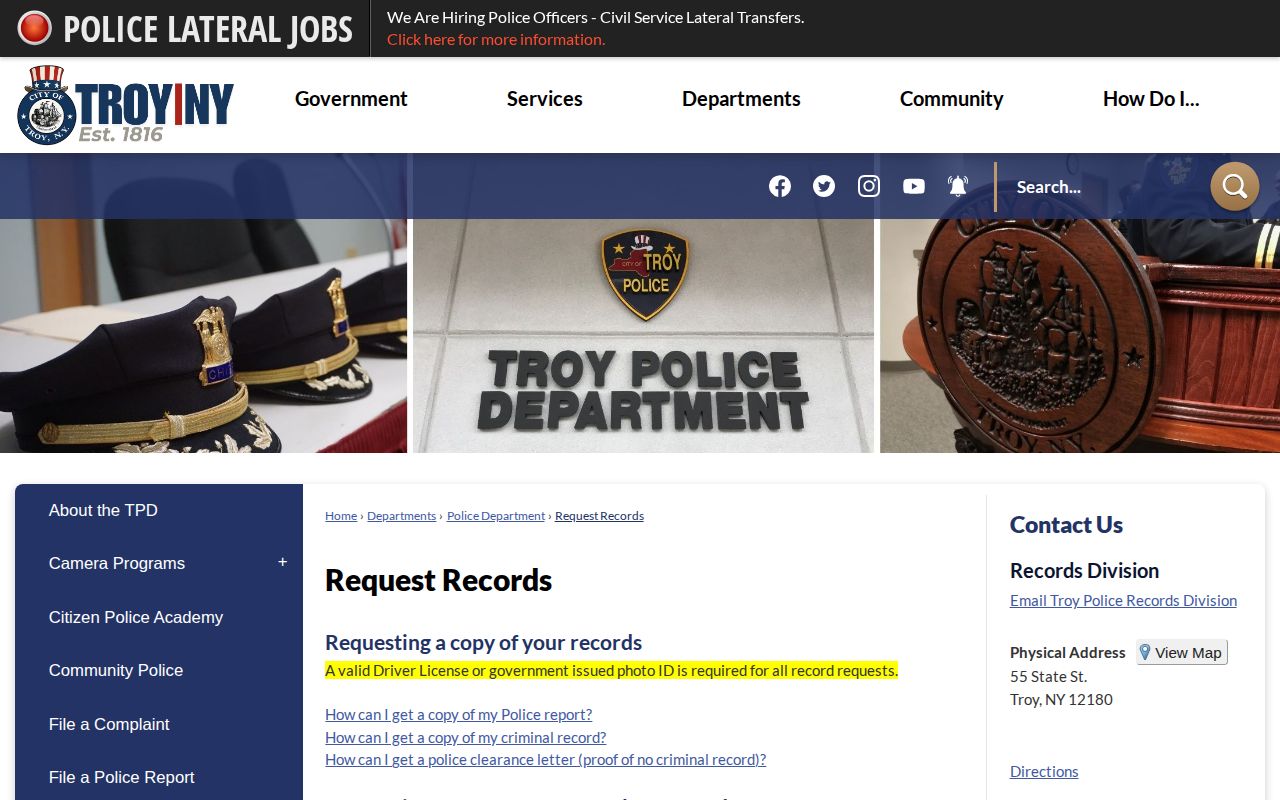
The capture distinguishes a police-report request from a live arrest roster.
55 State Street
Troy, NY 12180
518-270-4654 voicemail
tpdreports@troyny.gov
The official FOIL guidance explains city request rules and charges:
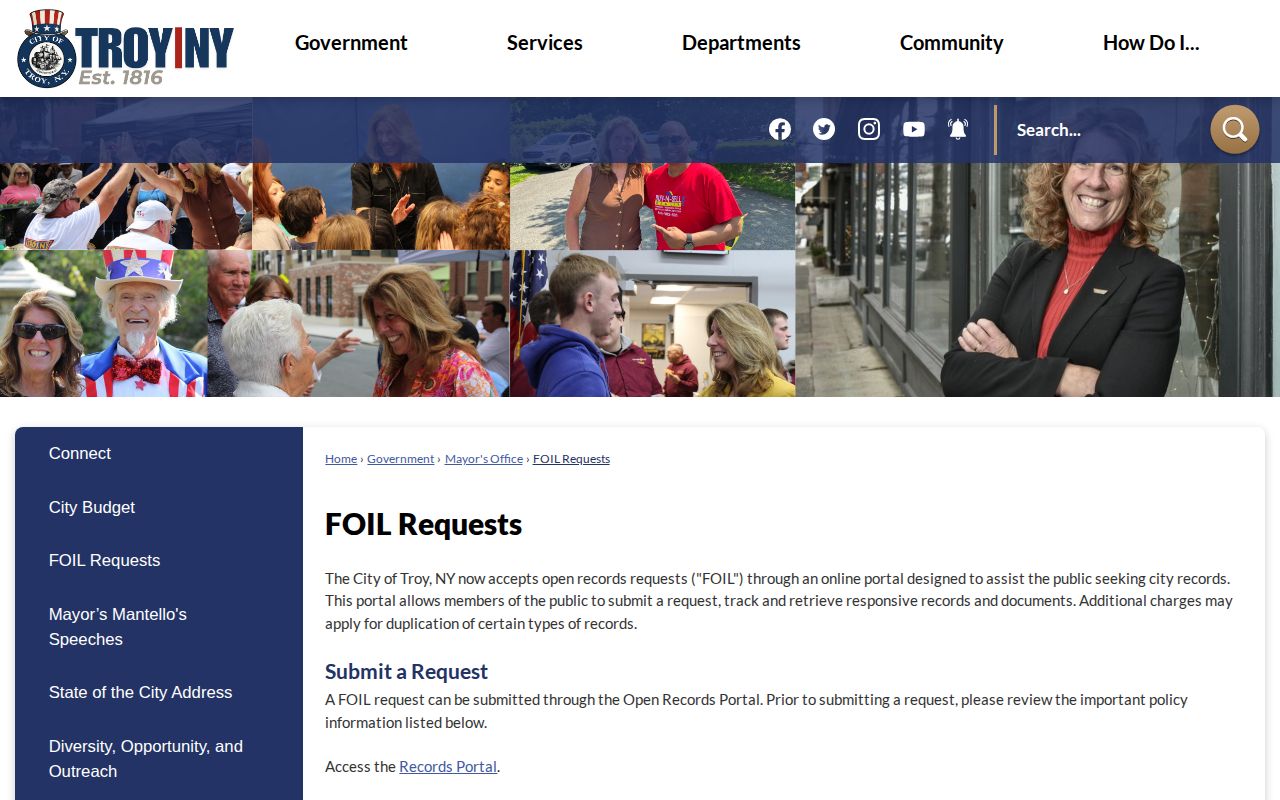
The fee schedule sets context only. It never promises that a specific booking photo will be released. Troy Police holds its incident reports. County booking material goes to the Sheriff or the county FOIL Officer. A court clerk, meanwhile, keeps the judicial file. Name the exact record narrowly and ask for a written decision.
When Troy Arrest Records Appear
Troy arrest information arrives on no single schedule. The city publishes no daily arrest list. Sheriff updates come as multi-day PDFs instead. Court data appears only after a case enters the judicial system, and VINE signals custody changes rather than fresh arrests. No office posts a weekend or holiday rule.
The sequence runs arrest → police processing → possible county booking → arraignment → release or remand → disposition. Arraignment is the first court appearance. Charges and release conditions get addressed there. Remand means the court orders continued custody. A report request, a VINE check, and a court search each match a different stage in that flow.
Old records need exact PDF names and date windows. An archived Sheriff narrative can stay online long after release, while a fresh Troy report may not exist yet. Treat every date as a marker on the record, never as proof that someone is still held.
Troy Arrests and Custody Labels
Troy arrest custody runs through one bureau. The Rensselaer County Correctional Facility opened in 1992. A construction project that county material places in 2009 through 2011 cost about $35 million and left the jail with 473 beds spread across 12 housing units. That single bureau handles the intake, so most local custody questions land there. Still, not every Troy arrest ends in a county jail admission.
Where a person sits also does not settle who holds the case. Under a U.S. Marshals agreement, federal detainees can be housed at the facility. County materials also cover ICE 287(g) activity. Federal pretrial custody, county detention, state imprisonment, and immigration processing are four different things. The label matters as much as the address.
- Police record
- Troy Police’s account of its incident or arrest.
- County custody
- Detention managed by the Sheriff’s Bureau of Corrections.
- State custody
- A sentenced person tracked through NYSDOCCS, not a new-arrest feed.
- Disposition
- The court outcome, which may differ from the booking charge.
Troy Arrest News Has Limits
Local outlets carry some Troy arrest and court coverage. Times Union and WNYT both run selected stories. The Troy Record is another lead, though it offers no stable current blotter section. Newsrooms pick what to cover, so a story is never a full city arrest list.
Aggregators are thinner here. Mugshots.com is the one major site with a direct Rensselaer County section, but its entries skew old and it holds no official standing. Busted Newspaper, RecentlyBooked, Arrests.org, and Mugshots.zone list no verified local section. Skip neighboring county pages too. Commercial listings can sit stale, miss arrests entirely, or attach the wrong name to a booking photo.
Go official first. Troy Police holds the report, VINE tracks custody changes, the Sheriff runs county operations, and the courts close the case. Do not lift images into a gallery. An old booking photo stays old no matter where it circulates.
Troy Arrest Records by Custodian
Send a records request to the office that created the record. Troy Police is the first stop for an incident or arrest report. The Sheriff's Bureau of Corrections keeps jail intake and custody records. It holds that material for anyone committed to the Rensselaer County Correctional Facility. The court clerk controls the arraignment, the filed charges, appearances, and the disposition. Each office describes the same arrest from a different stage. The dates and terms rarely match across documents.
Get the details ready first. List the adult's full name. Add the approximate event date, the arresting agency, and the exact document sought. Want the police action? Request the incident report. A booking sheet, release record, or custody confirmation matters in one situation only. It matters when county admission is at issue. For a booking photo, identify the image precisely. New York's privacy rule means disclosure is not guaranteed. If material gets withheld or redacted, ask for a written access decision.
Old files online deserve care too. A Sheriff PDF can stay visible long after a release. A Troy report may never hit a public feed at all. Retention rules do not make every record public. Sealed matters, juvenile identities, and victim details can stay restricted. When a source corrects itself, save the court disposition. Then ask that source to fix its own record rather than trusting a search result.